









|
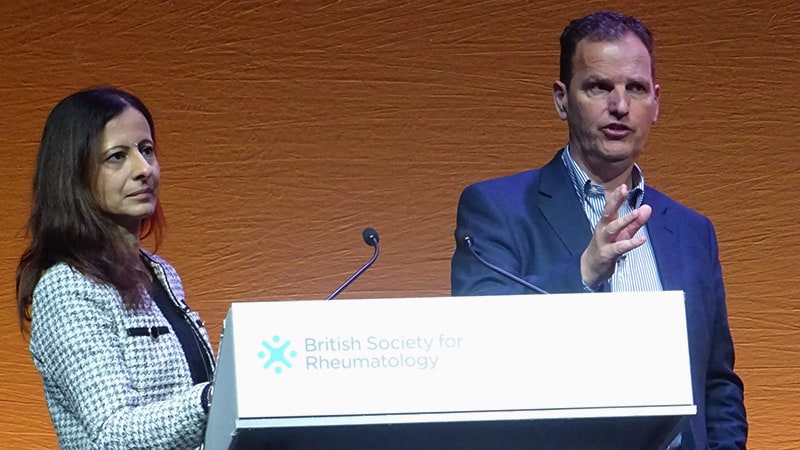
Dr Stuart J Connolly
|
The Optimal Pharmacological Therapy in Implantable Cardioverter Defibrillator Patients (OPTIC) trial also tested solo adjunctive therapy with sotalol, an antiarrhythmic agent with properties similar to those of both amiodarone and beta blockers. Sotalol wasn't as effective at preventing shocks and was less well tolerated than the amiodarone-beta-blocker combo, said Dr Stuart J Connolly (McMaster University, Hamilton, ON) when reporting OPTIC.
The magnitude of the problem of inappropriate ICD shocks was exemplified by the trial's patients who were on the beta-blocker-only standard of care, Connolly observed. Their shock rate approached 40%, with more than a third of the discharges inappropriate. The latter typically occurred because the ICDs, even the optimally programmed dual-chamber devices used throughout the trial, often misdiagnosed a supraventricular arrhythmia as ventricular tachycardia or ventricular fibrillation, he said.
Fear of such painful shocks can make patients anxious and diminish quality of life, Connolly observed. The dramatically reduced shock rates in OPTIC patients taking amiodarone along with a beta blocker suggests that the dual-drug regimen could potentially alleviate such fears, a concern that has not been well explored in ICD trials.
ICD treatment-delivery outcomes over one year in OPTIC, HR (95% CI) vs beta blockade alone| End point
| Amiodarone+beta blocker, n=140
| Sotalol, n=134
|
| Any shock
| 0.27 (0.14-0.52), p<0.001 | 0.61 (0.37-1.01), p=0.055 |
| Appropriate shock
| 0.30 (0.14-0.68), p=0.0035 | 0.65 (0.36-1.24), p=0.18 |
| Appropriate shock or antitachycardia pacing
| 0.30 (0.17-0.53), p<0.001 | 0.85 (0.55-1.31), p=0.46 |
| Inappropriate shock
| 0.22 (0.07-0.64), p=0.0055 | 0.61 (0.29-1.30), p=0.20 |
| Any shock after first 21 days of drug therapy
| 0.18 (0.08-0.37), p<0.001 | 0.52 (0.31-0.88), p=0.014 |
The OPTIC trial, sponsored by St Jude Medical, randomized 412 patients who had recently been implanted with dual-chamber ICDs to receive adjuvant metoprolol, bisoprolol, or carvedilol; one of the three beta blockers plus amiodarone; or sotalol alone. The ICD indication had been a history of cardiac arrest or spontaneous or inducible ventricular tachyarrhythmias with or without left ventricular dysfunction.
Asked at a press conference whether OPTIC suggests amiodarone should now be added to beta blockade in ICD patients like those in the trial, Connolly replied, "My inclination would be to do so." In his practice, he said, patients are typically already on amiodarone when they are referred for ICD implantation, but the drug is withdrawn once the device is in. "I think more and more we're going to carry on with low-dose amiodarone and try to prevent shocks from occurring. It's clearly effective and pretty well tolerated."
As humanists we must ask ourselves, how can we make this therapy more tolerable to our patients and reduce their anxiety?
Connolly said 18% of patients assigned to receive amiodarone had to stop taking the drug, but "the least well-tolerated drug was sotalol, which had a discontinuation rate approaching 24%." Amiodarone's adverse effects included hypothyroidism in 4.3%, pulmonary toxicity in 5.0%, and symptomatic bradycardia in 6.4%all greater rates than those in the beta-blocker-only group. "The side effects are real, but they're something we've been managing for years," Connolly told reporters. None of the drug regimens was associated with torsades de pointes, a marker of proarrhythmic risk.
ICD treatment-delivery outcomes over one year, absolute rates| End point
| Beta blocker, n=138
| Amiodarone+beta blocker, n=140
| Sotalol, n=134
|
| Any shock (%)
| 38.5 | 10.3 | 24.3 |
| Appropriate shock (%)
| 22.0 | 6.7 | 15.1 |
| Appropriate shock or antitachycardia pacing (%)
| 45.0 | 13.0 | 38.9 |
| Inappropriate shock (%)
| 15.4 | 3.3 | 9.4 |
| Any shock after first 21 days of drug therapy (%)
| 33.2 | 6.6 | 20.8 |
|
Dr Jeffrey J Goldberger
|
Dr Jeffrey J Goldberger (Northwestern University, Chicago, IL), the featured discussant for Connolly's presentation, put the OPTIC trial's contributions into the larger context of the often-overlooked impact ICDs have on patient quality of life. The devices are live-saving therapy, and research should continue to explore how to improve their use for optimal clinical effect, he said.
"But as humanists we must ask ourselves, how can we make this therapy more tolerable to our patients and reduce their anxiety?" Efforts toward that goal must be multidisciplinary, involving collaboration among clinicians, device programming designers, and mental-health professionals, among other groups, Goldberger observed. It will also require the use of better yardsticks for measuring anxiety and quality of life in ICD trials. "OPTIC, I believe, begins to open the discussion on a lot of these issues, but there's a lot more work to be done."
Goldberger presented preliminary data from more than 500 patients in his institution's ICD program that suggests how common it is for patients to be anxious about their ICDs. The majority of ICD recipients reported "daily preoccupation" with their device during the first couple of months after implantation, and 15% reported the same after a year. The emotional toll, he observed, can include generalized anxiety, depression, specific fears about the device going off, and body-image issues. The incidence of shocks increases this preoccupation, "so we need to deal with it."
ICD anxiety: Proportion of patients who report daily preoccupation with the implanted device| Days since implantation
| Rate of daily preoccupation (%)
|
| 0-30 | 69 |
| 31-60 | 64 |
| 61-180 | 33 |
| 181-240 | 21 |
| 241-360 | 15 |
| 361-720 | 12 |
| >720 | 14 |
| Connolly reports having received research grants and consultancy fees from St Jude Medical.
|
|
||||
|
|
|
|||
|
|
|
|||