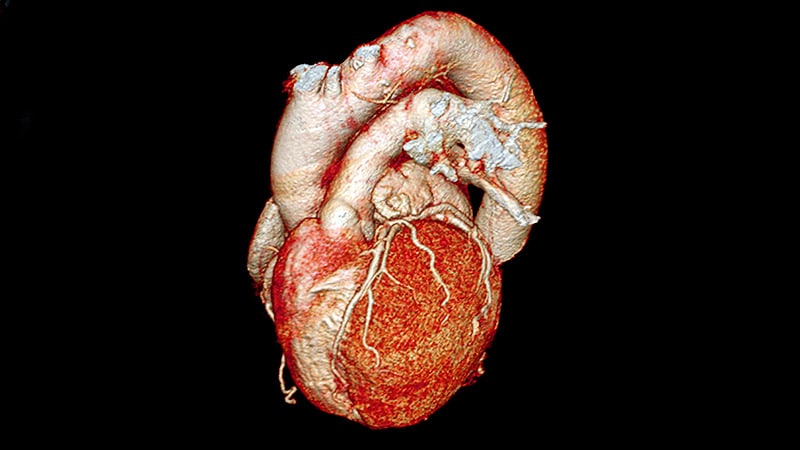







Waco, TX - In a bold new report, a team of clinicians, pathologists, researchers, and imaging specialists is calling for blanket screening of at-risk asymptomatic men and women for subclinical atherosclerosis using computed tomography (CT) and/or carotid ultrasound [1]. The Screening for Heart Attack Prevention and Education (SHAPE) task-force report, appearing as a Pfizer-funded supplement to the American Journal of Cardiology (AJC), recommends screening of all at-risk men between the ages of 45 and 75 and all women age 55 to 75 years unless they have none of the following: cholesterol >200 mg/dL, blood pressure >120/80 mm Hg, diabetes, smoking, family history, or metabolic syndrome.
"We believe . . . the time has come to replace the traditional, imprecise risk-factor approach to individual risk assessment in primary prevention with an approach largely based on noninvasive screening for the disease itself (subclinical atherosclerosis)," the report states.
Adding some heft to the proposed strategy, Dr Valentin Fuster (Mount Sinai School of Medicine, New York) is the guest editor (and reviewer) for the supplement and appears to give it a cautious endorsement in a note accompanying the paper [2].
Despite questions regarding [its] feasibility and practicality, the SHAPE guideline is a worthy and timely effort that . . . has the potential to transform the field of preventive cardiology.
"It is now obvious that new strategies are needed to fight the growing epidemic of atherosclerotic cardiovascular disease," Fuster writes. "In my view, the early detection and treatment of high-risk subclinical atherosclerosis is a leading candidate to fulfill that role. . . . Despite questions regarding the feasibility and practicality of such an ambitious proposal, the SHAPE guideline is a worthy and timely effort that goes beyond traditional risk assessment and has the potential to transform the field of preventive cardiology."
But while the report explicitly bills itself as "a new practice guideline for cardiovascular screening in the asymptomatic at-risk population," not everyone believes the terminologylet alone the proposed strategyis appropriate.
"It's an opinion, it's not a guideline that's been vetted through any kind of ecumenical group of people who have any official standing to make clinical-practice guidelines," Dr Robert Califf (Duke Clinical Research Institute, Durham, NC) told heartwire. "There's enough evidence to have an opinion about this; I don't think there's enough evidence to have a policy about it. It's an interesting idea and it could be right. Then again, it may not be right."
The manifesto
There's enough evidence to have an opinion about this; I don't think there's enough evidence to have a policy about it.
The SHAPE task-force report is part three in a series of papers summarizing satellite symposia proceedings dubbed "From Vulnerable Plaque to Vulnerable Patient" held during the American College of Cardiology (ACC) and American Heart Association (AHA) meetings over the past five years [3,4]. Chair of the SHAPE task force and lead author on the papers is Dr Morteza Naghavi (American Heart Technologies, Houston, TX), widely acknowledged as the impassioned voice behind the push to give cardiac imaging a leading role in preventive cardiology. Naghavi is also the founder and president of the Houston-based Association for Eradication of Heart Attack (AEHA), a not-for-profit organization dedicated to researching mechanisms, prevention, detection, and treatment of acute MI; it is also the organizing force behind the Vulnerable Plaque symposia and the SHAPE guidelines.
|
Dr Morteza Naghavi (Source: AEHA)
|
The SHAPE document outlines the use of imaging technology to measure coronary artery calcium (CAC) using computed tomography (CT) and carotid-intima-media thickness (CIMT) and plaque using carotid ultrasound. The document also includes a cost-effectiveness analysis based on a series of plausible assumptions. While other imaging technologies might play a future screening role, the authors say, it is these two that the SHAPE task force decided fulfilled the criteria of being sufficiently evidence-based (in terms of predictive value), widely available, reproducible, complementary to other risk-factor assessment tools, and cost-effective relative to the status quo.
The proposal hinges on the basic principle that traditional risk-factor screeningusing the Framingham Risk Score and the SCORE criteria in Europedoes a good job of identifying people at very low and very high risk of MI or stroke over a 10-year period but fails to single out "at-risk" men and women who represent everything in between. As Naghavi et al note in their proposal, the current AHA/National Cholesterol Education Program (NCEP)-sanctioned guidelines permit the use of noninvasive screening tests as an option for additional risk assessment in "appropriately selected" individuals, at the physician's discretion.
"What's really new about [the SHAPE task-force report] is it really expands the types and numbers of individuals who are recommended for screening and moves imaging screening to the forefront," Dr Allen J Taylor (Walter Reed Army Medical Center, Washington, DC), a member of the editorial committee for the report, told heartwire. "So it is a broader effort in trying to get people screened for heart disease through a combination of traditional approaches and newer approaches like imaging; what's controversial is the low bar it sets for screeningit's virtually all middle-aged men and women who are not known to be extremely low risk, which is pretty much everybody. So it's a bit forward-thinking in that regard; whether that's a tenable position is a matter for debate."
The members of the writing committee, editorial committee, and advisorsas they are categorized according to their level of participation in the reportinclude some well-known names in cardiology and, in particular, cardiologists who have been at the forefront of cardiac imaging research. Yet the report itself has no official backing from the professional associations or bodies typically responsible for drawing up guidelines: the AHA, ACC, or the National Heart, Lung, and Blood Institute (NHLBI) and its NCEP.
|
We began to think, this is really crazy, we need to do something better; we should not be simply inventorying risk factors.
Experts acknowledge the simmering sense of frustration over the slow integration of modern imaging techniques into risk-factor screening. Naghavi speaks persuasively about the current "tunnel vision on risk factors." Likewise, Dr Prediman K Shah (Cedars-Sinai Medical Center, Los Angeles, CA), chief of the SHAPE editorial committee, described the AEHA's work in the field as "a labor of love. . . borne out of a sense of frustration and wanting to do something that would have an impact" in terms of preventing sudden cardiac death.
|
Dr Prediman K Shah (Source: Cedars-Sinai Medical Center)
|
"We are seeing patients who are considered not to be at risk based on Framingham assessment still having heart attacks and sudden death," Shah told heartwire. "We began to think, this is really crazy, we need to do something better; we should not be simply inventorying risk factors, we should be looking at the aggregate effect of known and unknown risk factors by actually examining the arteries directly to see whether the person has subclinical atherosclerosis or not."
Douglas agrees. "There's no question that there is a sense of frustration about why we haven't done better," she said. "Disability and mortality for acute MI has plummeted over the past 20 or 30 years, but at the same time, more people are getting heart disease than ever. . . . It's almost a failure of healthcare, that people develop cardiac disease. We know who is going to develop cardiac disease: we have a robust set of risk factors, we've got these screening tools that are diagnostic tests that have been proven in large populations over years and years to predict risk, we have therapeutic agents and therapeutic lifestyle adjustments that have also been proven to protect secondary prevention and even primary prevention. Why can't we put this together and keep people healthy?"
|
Dr Pamela Douglas (Duke University)
|
Even Bild, who emphasizes that the SHAPE document does not constitute "consensus guidelines," appreciates the fertile grounds from which it sprang.
"The basis for these recommendations is quite understandable, and that impatience is understandable both because there is a desire to prevent CVD and because these screening tests are available and they do predict disease. The problem is that what precisely should be done based on the test results is not entirely clear."
In the absence of evidence
And there's the rub, experts say. While evidence is accumulating that presence of atherosclerosis on imaging tests may be a better predictor of risk than presence or absence of traditional risk factors, no large randomized, controlled trials have demonstrated that patient outcomes are improved.
"There's this belief, and I think it's a tenable belief, that screening is effective at incrementally identifying risk," Taylor told heartwire. "But then where it breaks down is that the identification of risk has to lead to meaningful changes in management and patient behavior that downstream prevents events. And that hasn't been demonstrated. So it really acts on faith that on identification of risk, treatments would be fully and uniformly used, the harms and costs would be outweighed by benefits, and downstream more events would be prevented, and that's something that has not been fully worked out."
We don't have . . . the evidence that they can make a difference, whereas we do have an enormous amount of data that identifying people with high cholesterol or high blood pressure and treating them to goal can have a major impact in terms of clinical outcomes.
Bonow agrees. "Clearly, these imaging techniques are exciting, they're evolving, and they may be valuable. We know they can detect disease, but what we don't have is the evidence that they can make a difference, whereas we do have an enormous amount of data that identifying people with high cholesterol or high blood pressure and treating them to goal can have a major impact in terms of clinical outcomes. Calling these 'guidelines' is a little premature, because we don't have outcome evidence."
But others point out that the evidence supporting imaging tests like mammography for cancer screening is no better than the evidence for cardiovascular imaging. "The amazing thing is, screening for cancer is reimbursed, but screening for the most common disease that leads to deathCVDis not reimbursed, and that's the paradox," Shah commented.
Naghavi is pragmatic: "Physicians want their patients to receive the best care, but the problem is they need to be reimbursed. A few insurance companies have realized this, although none of the big players, but unless Medicare supports this, the chance of getting a national adoption would be small."
Where everyone agrees is that clinical trials are warranted but the scope and cost of a trial are prohibitive. "We filed a report with NHLBI that said there should be a randomized trial of a strategy that looks pretty much like this vs usual care," but it was rejected, Califf said. "I would bet that trials like that will be done when and if the [National Institutes of Health] NIH budget gets restored," he predicted, adding that he gives the AEHA credit for putting forward "a strong case."
"I hope this actually leads to doing a randomized trial that would answer the questions," he said.
Asked whether the NHLBI is currently contemplating such a trial, Bild said no, although she acknowledged that it had been discussed in the past. "Such a study would be extremely expensive to conduct, but that doesn't mean the NHLBI would never do it."
Other hurdles
While the absence of incontrovertible proof is the overriding criticism of the proposed screening approach, additional quibbles emerged in interviews with heartwire.
First and foremost were concerns about industry sponsorship. Naghavi insisted to heartwire that full transparency is key to the broad acceptance of the guidelines and was happy to provide disclosure information for everyone associated with the proposal. Pfizer has been the "platinum" sponsor of the Vulnerable Plaque satellite symposia, but others, including GlaxoSmithKline, GE Healthcare, Bristol-Myers Squibb, DiaDexus, CV Therapeutics, and many more, have all been cosponsors in the past. The AEHA website was paid for by Pfizerroughly US $20 000 according to Naghavias was the AJC supplement (US $55 800)but cardiologists and others associated with the AEHA and the SHAPE task force have worked on a volunteer basis, Naghavi stated. He himself has not yet drawn a salary from the AEHA but says he hopes to in the future. Membership in the AEHA is free.
Notably, the first two Vulnerable Plaque publications were published in Circulation and were authored by a veritable Who's Who of cardiologymany of the most prestigious names do not appear on this third publication.
Technological aspects of the proposed strategy also came under scrutiny in interviews with heartwire. Douglas pointed to the very different regulatory approval granted to imaging technology as compared with drugs. "If an imaging company develops a new imaging technique, the 510K approval is a very low bar, especially compared with medications and what we expect of them to be sold in the marketplace."
|
Dr Robert Califf
|
Similarly, Califf noted that even if screening were accepted as a strategy, the next issue would be regulating the quality of the screens themselves. "If you look at mammography as an example, there are very rigid standards now and certification for doing screening mammography, you can't just set up shop and start doing it," he said.
There are also the risks to patients, not only of taking drugs with known toxicities deemed appropriate on the basis of imaging results, but also from radiation exposure. Fewer and fewer centers use plain old electron-beam (EB) CT and instead would likely use multislice CT, which images the heart as well as the arteries but delivers a much higher radiation dose than the EBCT of yesteryear.
Once you tell somebody that they actually have the disease and match them to the risk factors, they tend to get religion in terms of actually being motivated to change their behavior.
Other, less-tangible risks are difficult to distinguish from the purported benefits.
Many advocates of CAC and CIMT screening have long argued that the scans have the power to motivate physicians and patients alike. "Once you tell somebody that they actually have the disease and match them to the risk factors, they tend to get religion in terms of actually being motivated to change their behavior and take medication that they ordinarily would not have agreed to take," Shah explained. But Taylor, who published a 2003 paper in the Journal of the American Medical Association specifically testing this theory, challenges that. As reported by heartwire, his study showed that seeing evidence of CAC did not appear to result in patients being more motivated to make lifestyle changes [5].
"How many people read the warning labels on cigarettes and continue to smoke?" Taylor asks. "How many step on a scale and say, oh my god, and eat less that day and then go right back to the same behavior? It's not the epiphany that people think it is."
Indeed, Taylor thinks the strategy could actually backfire, at least in terms of patient effects. "We know that labeling people with hypertension, which is another asymptomatic diagnosis, actually is a measurable detriment to quality of life, so it's reasonable to assume that labeling someone with atherosclerosis would also be detrimental to their quality of life. Imagine your quality of life after you've been told you're sick and have to take pills the rest of your life."
But Taylor also argues that to focus on patient behavior may be the wrong approach: "If it's something that motivates physicians to be more attentive and use the right medications, that's a good thing in itself."
Other, more benign, influences may also have a handnamely professional interests, reputations, and an unshakable belief in the power of imagingat least among the believers.
"Knowing most of the people on this paper, I would say they are well motivated but not unbiased," Califf told heartwire. "Most of them have devoted their lives to developing better methods of imaging and of course to making earlier diagnoses of vascular disease and doing something about it, so it's hardly surprising that they'd also be providing clinical services related to that effort, for something they believe in. But the beauty of professional societies and government guidelines and performance measures is that people who are not financially or conceptually biased toward a particular point of view must vet these things."
The way forward
Shah believes, however, that the momentum is growing, as is the pool of professionals who believes things should change. "This is true of every medical innovation: initially there is significant skepticism, and eventually the studies come out and you can begin to see that there's something here that makes sense. . . . It's going to take some time for us to convince the Framingham mafia that we can do a better job by incorporating imaging into that scale, but I also don't think it's a case of either/or; I think we need both, because you need to know what the risk factors are to modify them." Indeed, everyone interviewed by heartwire, while supporting or rejecting the SHAPE proposal to varying degrees, agreed that imaging deserved a bigger role in risk prediction.
This group is . . . a group with passion, but I think the technology they're talking about is evolving slowly.
Fuster, in an interview, emphasized that the primary goal of publication was education and said he did not think the time had come for full adoption of a blanket screening approach. "It's still expensive, it's still not sensitive and specific enough, and it still has some radiation, at least in the case of CT. My view of this group is very positive, it's a group with passion, but I think the technology they're talking about is evolving slowly. You need these kind of passionate people, and particularly in this context, they are doing a very good job."
|
Dr Valentin Fuster
|
New imaging guidelines from the AHA and ACC are currently under review and anticipated to be released in the fall. And while the SHAPE task-force report may appear to be a preemptive strike, from a mix of zeal and impatience, Douglas points out that imaging strategies are already widely in use. "There are screening tests available, people are using them as screening tests, they're being marketed directly to the public in some cases, and the patient-care algorithms are not necessarily being done appropriately, intelligently, or in a uniform way. So in some ways, actually, practice has gotten ahead of the guidelines, rather than the guideline proposal getting ahead of practice."
Califf observed that as long as patients are willing to pay for information, some physicians would be happy to provide it. "It's a matter of political philosophy whether you think that's the right thing to do, but there's plenty of people in Minneapolis-St Paul who have enough money that if they want to go in and get a carotid ultrasound and a calcium score, they just pull out their credit card and pay for it."
Naghavi himself acknowledges that the direct-to-consumer marketing is one thing holding the field back. "The company that developed EBCT did the greatest disservice to the field. They were too excited about the technology to collect the evidence we have now. But this should not be the reason for healthcare national policy makers to think that because there were some wrongdoings, they will not consider the evidence. This is a problem of the entire culturewe care more for sick-care than healthcare, and I don't think we would be able to make a huge impact overnight, but this is the first step."
Whether clinicians will be eager to incorporate this imaging strategy in their practices or wait for "true" guidelines is anyone's guess.
"Individual clinicians are going to have to make some of these decisions on their own, because we just don't have the evidence yet to say yes or no, this is the way to go," Bild acknowledges. "And unfortunately, much of medicine is practiced in that context, in the face of imperfect evidence."
Douglas agrees: "Everybody's got their own bar. There are 30 or 40 well-recognized cardiologists and scientists on this document who think this strategy is reasonable."
Even AJC editor Dr William Roberts (Baylor College of Medicine, Waco, TX), who cautioned against oversimplifying the subject of vulnerable plaque, its role, and its detection, told heartwire, "I don't think any government authority or the two major cardiological organizations have any unequivocal authority" over how clinicians run their practices.
And sometimes a lack of evidence can't keep a field from moving forward. "One of the problems when government organizations are sponsors of guidelines is that they can't say anything without absolute proof that it's accurate," Roberts commented. "That's not the real world. If you have to prove something in court, then those are the things you have to go with, but I don't think it's always the best thing for patient care."
| Bonow is a consultant for Bristol-Myers Squibb medical imaging. Douglas serves as a consultant to and/or receives support from GE Healthcare, Northpoint Domain, and Medtronic; she holds shares in CardioDX, GE Healthcare, Genentech, Millennium, Momenta Pharmaceuticals, and Northpoint Domain. Naghavi has served as a scientific advisor to and/or received support from Pfizer Inc and diaDexus and is a consultant to and shareholder in Endothelix and Volcano Corp; Taylor receives research/grant support from Kos Pharmaceuticals and has received educational honoraria from Kos Pharmacueticals, Pfizer, and Wyeth.
|
-
Naghavi M, Falk E, Hecht HS, et al. From vulnerable plaque to vulnerable patient: Part III. Introducing a new paradigm for the prevention of heart attack; identification and treatment of the asymptomatic vulnerable patient. Screening for Heart Attack Prevention and Education (SHAPE) task force report. Executive summary. Am J Cardiol 2006; DOI: 10.1016/j.amjcard.2006.03.002. Available at http://www.ajconline.org.
-
Fuster V. Foreword. Am J Cardiol 2006; 98suppl):vi.
-
Naghavi M, Libby P, Falk E, et al. From vulnerable plaque to vulnerable patient: a call for new definitions and risk assessment strategies: Part II. Circulation 2003; 108:1772-1778.
-
Naghavi M, Libby P, Falk E, et al. From vulnerable plaque to vulnerable patient: a call for new definitions and risk assessment strategies: Part I. Circulation 2003; 108:1664-1672.
-
O'Malley PG, Feuerstein IM, Taylor AJ. Impact of electron beam tomography, with or without case management, on motivation, behavioral change, and cardiovascular risk profile: a randomized controlled trial. JAMA 2003; 289:2215-2223.
|
||||
|
|
|
|||
|
|
|
|||
|
|
|
|||
|
|
|
|||
|
|
|
|||
|
|
|
|||
|
|
|
|||
|
|
|
|||
|
|
|
|||
|
|
|
|||
|
|
|
|||
|
|
|
|||
|
|
|
|||
|
|
|
|||
|
|
|
|||
|
|
|
|||
|
|
|
|||
|
|
|
|||
|
|
|
|||
|
|
|
|||
|
|
|
|||
|
|
|
|||
|
|
|
|||
|
|
|
|||
|
|
|
|||
|
|
|
|||
|
|
|
|||
|
|
|
|||
|
|
|
|||
|
|
|
|||
|
|
|
|||
|
|
|
|||
|
|
|
|||
|
|
|
|||