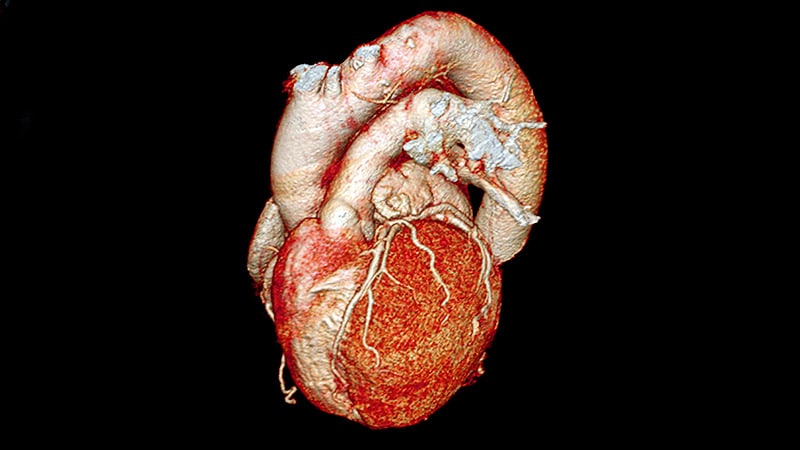










Chicago, IL - Despite the increasing use of multislice computed tomography angiography (CTA) to assess the coronary arteries, a high rate of false positives and nonevaluable scans should curb enthusiasm for this fast-evolving technology, a new study suggests [1]. In the Coronary Assessment by Computed Tomographic Scanning and Catheter Angiography (CATSCAN) study, one of the first large-scale multicenter studies to assess 16-slice CTA against the gold standard, conventional angiography, researchers found that although the sensitivity of CTA was high, specificity was low, and almost 30% of the CT scans could not be interpreted.
In an interview with heartwire, Dr Mario J Garcia (Cleveland Clinic, OH), lead author on the study, pointed out that CT technology has become more sophisticated since the CATSCAN study was launched. But whereas 64-slice scanners have substantially improved the ability to accurately image the coronaries, many people are still using 16-detector machines in their practice.
"At least this should raise a concern among the general population and medical insurance companies that 16-detector scanners should not be used widely as a first-time test," Garcia said. "I believe that people using 64-slice scanners will think these findings relate to the previous generation of technology, but the results raise some concern about applying these tests indiscriminately to any person who wants to have it done. You could end up sending those people for unnecessary secondary tests, including cardiac cath."
Garcia et al's study appears in the July 26, 2006 issue of the Journal of the American Medical Association.
Indiscriminate use ill advised
CATSCAN was conducted at 11 sites in the US, Europe, Israel, Japan, and Argentina, with all CTA and standard angiography scans being analyzed at independent core labs in Ulm, Germany and Cleveland, OH, respectively. In all, 187 patients with suspected coronary artery disease (CAD) underwent multidetector CT (MDCT), followed by conventional angiography within 14 days; sensitivity and specificity for the detection of >50% stenosis (based on quantitative coronary angiography) were calculated on a patient basis and on the basis of arterial segments, of which a total of 1629 were imaged in the study.
Of note, only 71% of the 1629 segments imaged on CT were evaluable by the core lab. Using the assumption that all nonevaluable segments were positive, the sensitivity for detecting stenoses >50% on MDCT was 89%; the specificity, however, was much lower, at 65%. In patient-based analyses, sensitivity for detecting at least one segment with >50% stenosis was 98%, but the specificity was 54%.
"In our study, if you had a negative result on a CT, you could virtually exclude having CAD. In fact, we could have excluded almost 40% of the patients that went on for catheterization based on CT alone," Garcia said. "On the other hand, if you have a positive result on CT, it's not always positive, sometimes it's a false positive, and sometimes the CT shows some artifact that doesn't allow you to interpret the scan. The message is that CT should not be used indiscriminately, because if it's too widely applied, without having good clinical indication, it could lead to overdiagnosis."
Although the CT results aren't as promising as earlier studies have suggested, Garcia et al point out that previous research has been largely single-centered and might have used different imaging or analysis protocols or enrolled patients with different disease characteristics.
Until CTA specificity improves, Garcia believes stress testing should remain the primary diagnostic tool, with patients who have clear signs of CAD heading directly to conventional coronary angiography. CTA, however, still has a niche, particularly as technology continues to improve.
"The best use of CTA, according to the results of our study, would be for patients who have equivocal stress-test results, [such as a] result that is uncertain or suspected to be false positive or false negative; then the CT is a good test to confirm or exclude coronary disease," Garcia said. "CT as a first test should be used only in a selected population, perhaps in patients of younger age in whom the likelihood of having a lot of calcium in the coronaries is low. . . . The people who should go straight to angiography are those in whom it is very clear, based on clinical grounds, that they have coronary disease: patients who present with typical angina symptoms and multiple risk factors and perhaps ECG changes. They have such a high probability of disease, they should go directly to coronary angiography."
|
||||
|
|
|
|||
|
|
|
|||
|
|
|
|||
|
|
|
|||
|
|
|
|||
|
|
|
|||


Blinklist
delicious
Digg
Facebook
Furl
Google
LinkedIn
ma.gnolia
Mixx
Reddit
Stumbleupon
Twitter
Y! Bookmarks
Yahoo Buzz