









|
Dr Hugh Calkins
|
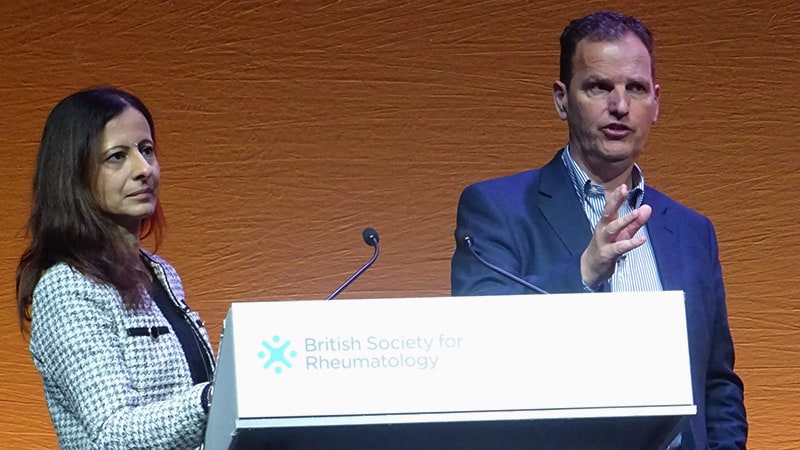
"Atrial fibrillation is an enormous problem affecting millions of people worldwide," said Dr Hugh Calkins (Johns Hopkins University Medical Center, Baltimore, MD), task force cochair and first author of the expert consensus statement. "At this point, the mainstay of treatment has been anticoagulation to prevent strokes and antiarrhythmic drug therapy, but increasingly, patients are undergoing catheter or surgical ablation of atrial fibrillation, something that has become more common in the past two or three years. We recognize there is a need to provide physicians with updated information about ablation as well as a need to provide standards for these procedures."
Presented here this week at the Heart Rhythm Society 2007 Scientific Sessions, the consensus statement was developed by the Heart Rhythm Society, the European Heart Rhythm Association (EHRA), and the European Cardiac Arrhythmia Society (ECAS), in collaboration with the American College of Cardiology, American Heart Association, and Society of Thoracic Surgeons. The report will be published later this month in Heart Rhythm.
Goal is to improve patient outcomes
|
Dr Josep Brugada
|
The most common of the cardiac arrhythmias, atrial fibrillation is known to significantly increase the risk of stroke as well as cardiovascular death and overall mortality. It also adversely affects quality of life. Although treatment with antiarrhythmic drugs and anticoagulation is considered front-line therapy in patients with symptomatic AF, these therapies are recognized as suboptimal, with potentially serious adverse effects.
For this reason, the use of catheter ablation to treat atrial fibrillation, although not without its risks, has been alluring.
"Atrial fibrillation is impacting our day-to-day practice and, as atrial fibrillation is becoming a real option for treatment, this means that we need more physicians and departments trained and prepared to be able to offer it to our patients," said task force cochair and president-elect of the EHRA Dr Josep Brugada (University of Barcelona, Spain). "This is why it is important that this document was developed, so that we can develop standards for our patients."
|
In addition to the indications for ablation therapy, the task force also spent considerable effort determining postprocedure anticoagulation strategies to prevent stroke. While warfarin is recommended for at least two months following ablation, decisions regarding the use of warfarin after two months should be based on the patient's risk factors and not on whether the ablation procedure was considered successful. Stopping warfarin is not recommended for patients who have a CHADS (congestive heart failure, hypertension, age, diabetes, and stroke) score >2.
"That means that for the 50-year-old patient with no risk factors for stroke who undergoes an atrial ablation procedure, they need to be on Coumadin for two months, but then you can stop it because they never needed to be on Coumadin in the beginning, regardless of their atrial fibrillation," said Calkins.
|
The task force also stressed that catheter ablation, in general, "should not be considered as first-line therapy." Moreover, a patient's desire to eliminate the need for long-term anticoagulation should not be considered an appropriate selection criterion.
"Our goal, and [that of] everybody involved in atrial fibrillation ablation, is to develop a safe and effective procedure that can be applied broadly to patients worldwide who have paroxysmal and persistent atrial fibrillation," said Calkins. "Our hope is that within the next five years these procedures will be associated with long-term success rates greater than 90% and complications rates less than 1%."
No 100% consensus on technique
Although the consensus report represents the input from heart rhythm experts in the US and Europe, the task force did not formalize any one specific technique or ablation approach. The group did state that ablation strategies targeting the pulmonary veins and/or pulmonary antrum are the cornerstone for most AF procedures and that if the pulmonary veins are targeted, complete electrical isolation is the goal.
For patients with persistent atrial fibrillation, said Calkins, there is general agreement that additional lesions, along with pulmonary vein isolation, will be required. However, the procedure remains variable, and there is no perfect consensus on what additional lesion sets are needed. In addition, there is no consensus as to whether clinicians should attempt additional lesions in these patients on the first ablation, rather than wait until determining whether an additional "touch-up" ablation procedure is needed.
"In patients with persistent atrial fibrillation, one of the questions that comes up is whether it is best to go in and do an extensive ablation procedureisolate veins, draw lines, ablate rotors, and spend five, six, or seven hoursuntil you terminate atrial fibrillation or whether it is best to isolate the veins, which is successful in 50% of patients," said Calkins. "In the 50% that fail, those patients can come back for the aggressive procedure. Different centers throughout the world have different approaches as to how aggressive to become on the first procedure. For me, I prefer a stepwise approach."
Brugada noted that many experienced centers are now capable of tackling complex patients with atrial fibrillation, and, rather than box clinicians in with strict techniques and ablation approaches, the guidelines leave open the possibility of different approaches that will allow researchers to learn more about how to better treat these patients.
Banning the "cure" word
One word that is not mentioned in the consensus guidelines is "cure," specifically because the task force recommends that it not be used. Instead, Calkins told heartwire that ablation is a "treatment" for atrial fibrillation.
"To say 'cure,' you really need five years of follow-up with no recurrences, and we just don't have that," he said. Most centers do see some recurrence, usually around the two-year mark, he noted.
Other missing data are studies showing that treating atrial fibrillation with ablation prevents mortality. One study is attempting to answer that. The Catheter Ablation vs Antiarrhythmic Drug Therapy for Atrial Fibrillation (CABANA) trial is designed to test the hypothesis that in patients with new-onset atrial fibrillation a treatment strategy of catheter ablation is superior to rate control or antiarrhythmic drug therapy to reduce the primary end point of total mortality. Up to 3000 patients will be enrolled in this trial and will be followed for an estimated duration of five years.
- Calkins H, Brugada J, Packer DL et al. HRS/EHRA/ECAS expert consensus statement on catheter and surgical ablation of atrial fibrillation: recommendations for personnel, policy, procedures, and follow-up. Heart Rhythm Society 2007 Scientific Sessions; May 9, 2007: Denver, CO. DOI: 10.1016/j.hrthm.2007.04.005.
|
||||


Blinklist
delicious
Digg
Facebook
Furl
Google
LinkedIn
ma.gnolia
Mixx
Reddit
Stumbleupon
Twitter
Y! Bookmarks
Yahoo Buzz