







London, UK - A new study has found that ECGs have little incremental value on top of clinical assessment for prognosis in patients with suspected angina [1]. Dr Neha Sekhri (Newham University Hospital, London, UK) and colleagues' findings are published online November 13, 2008 in BMJ.
Senior author Dr Adam D Timmis (Barts and the London Queen Mary's School of Medicine and Dentistry, London, UK) told heartwire that the findings emphasize the importance of the clinical history and assessment in such patients. "What we found is that if doctors base risk stratification on ECG, that's a complete waste of time. If they base it on exercise ECG, they will miss patients who go on to have events. That's exactly what we discovered: that a significant proportion of patients who went on to have events had had a completely normal exercise ECG. So don't rely on the exercise ECG as a 'rule-out' for future events in this group of patients," he cautions.
Don't rely on the exercise ECG as a 'rule-out' for future events in this group of patients.
Timmis says "better tests" are needed in this patient population, but crucially, the newer imaging technologiessuch as computed tomography angiography (CTA), MRI, and stress echohave not been evaluated in those with suspected angina. "It's no good extrapolating from patients who've had an infarct to this group of patients," he says.
In an accompanying editorial [2], Dr Beth Abramson (St Michael's Hospital, Toronto, ON) says long-term prediction of risk and the incremental usefulness of the ECG have not previously been evaluated in this way. "The study is a reminder of the importance of taking a detailed history and making a thorough physical examination and that additional information from the ECG is helpful in some patients but does not predict risk in everyone," she notes.
47% of events in follow-up were in those with normal ECGs
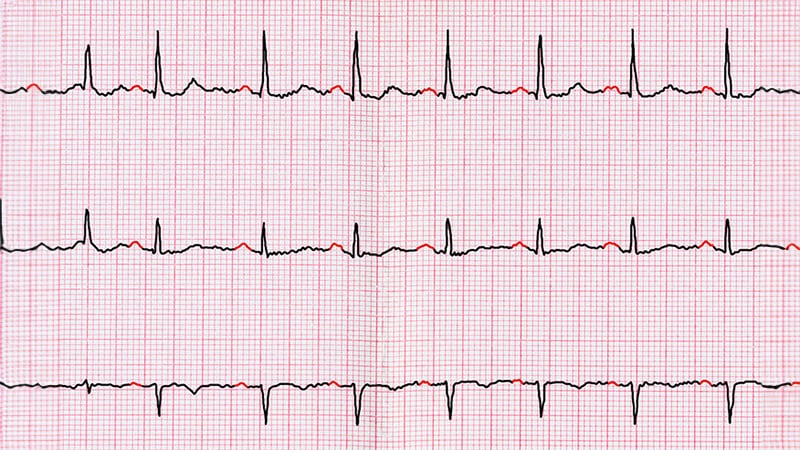
In the study, performed in rapid-access chest-pain clinics in six hospitals in the UK, 8176 consecutive patients with suspected angina and no previous diagnosis of coronary artery disease all had a clinical assessment, and then resting ECG was taken and recorded. The aim of the study was to determine whether resting and exercise ECGs provide prognostic value that is incremental to that obtained from the clinical history in such patients, as accurate identification of those at higher risk of ACS and death is essential to tailor management strategies, the researchers explain.
Of the patients, 4848 had an exercise ECG performed and 1422 of these had more detailed exercise ECG data recorded. The main outcome measure was a composite of death due to coronary heart disease or nonfatal ACS during median follow-up of 2.46 years.
Risk-stratified cumulative probabilities of the primary end point at one year and six years for all three prognostic indices (clinical assessment only, clinical assessment plus resting ECG, and clinical assessment plus exercise ECG) showed only small differences at all time points and at all levels of risk.
ECG added nothing, and the incremental value of the exercise ECG was pretty miniscule.
"We found that the resting ECG and the exercise ECG are both not bad at identifying high-risk patientsthose who have abnormal tests tend to go on to have future events, which is the conventional wisdom," said Timmis.
But crucially, 47% of all events during follow-up occurred in patients with a negative exercise-ECG result, emphasizing the limitations of using ECGs for risk assessment, say the researchers, "and reminding us that the demonstration of a test's independent prognostic value does not imply clinical utility if it is not incremental to information obtained more simply from the history and examination."
"The important point is the incremental value of ECGs over and above the clinical assessment," Timmis says. "ECG added nothing, and the incremental value of the exercise ECG was pretty miniscule. Better tests are needed."
Abramson agrees: "The stress test and ECG are not foolproof predictors of risk, and other methods need to be tested." But, she stresses, "even though [ECGs] cannot predict all future events, they are a necessary extension of the physical examination in patients with suspected angina."
Timmis says he would not go so far as to say that ECGs should be abandoned in such patients, because "they will continue to have a role for diagnostic purposes. For example, a patient comes into the clinic with chest pain. You do an ECG and you might find they have ST-elevationsthey are having an acute myocardial infarction."
Newer tests should be studied in those with suspected angina
Timmis says studies of contemporary tests are desperately needed in those with suspected angina: "A proper evaluation of newer technologies has not been undertaken in this group of patients, and it needs to be undertaken."
If they don't add anything, there's no point using them.
Also, most research on these newer and costlier technologies has focused on their suitability for diagnosing coronary disease, with less attention paid to incremental value for risk assessment, he notes.
And crucially, he says, "the problem with these tests is that they all get evaluated in terms of whether they have a high sensitivity/specificity for identifying future eventsbut so has the ECGwhen what they need to examine is what the incremental value of these tests is over and above the exercise ECG and clinical assessment. If they don't add anything, there's no point using them.
"A prerequisite of any new test should be the demonstration of its incremental value over clinical assessment if risk stratification is to be improved and the potential for chest pain clinics to reduce coronary mortality is to be fully realized."
-
Sekhri N, Feder GS, Junghans C, et al. Incremental prognostic value of the exercise electrocardiogram in the initial assessment of patients with suspected angina: cohort study. BMJ 2008; DOI:10.1136/bmj.a2240. Available at: http://www.bmj.com.
-
Abramson B. Electrocardiography in suspected angina. BMJ 2008; DOI:10.1136/bmj.a2340. Available at: http://www.bmj.com.
|
||||
|
|
|
|||
|
|
|
|||
|
|
|
|||
|
|
|
|||
|
|
|
|||
|
|
|
|||
|
|
|
|||
|
|
|
|||
|
|
|
|||
|
|
|
|||
|
|
|
|||
|
|
|
|||
|
|
|
|||
|
|
|
|||